
![Carlos Santos 9899 Handgrade Oxford in Black Calf for The Noble Shoe Side]()
 The $500 Dress Shoe Question: Spending More (Often) Saves You Money
Let’s get something out of the way: this isn’t going to be one of those articles where I tell you that buying expensive shoes makes you a better person or more stylish. It doesn’t. Plenty of people in $1200 oxfords are still wearing them with white sport socks at a wedding or unhemmed trousers so let’s not confuse price with taste.
But the math? The math is real. I’ve been collecting and wearing dress shoes from so many brands in the last 8 years, I think I have enough data and experience to talk about it.
I am sure there’s been a time where you found yourself in front of a pair of proper shoes — Goodyear welted, smooth calf, the kind that smells like a leather workshop — but you thought “there’s no way I can justify spending that much“. In fact, a friend of mine recently told me “There’s no way I’m spending $1000 on loafers“. The same man has a GeForce RTX 5090 by the way.
Here’s the uncomfortable truth: the cheap shoes you’ve been buying are costing you more. Not in feeling, in actual money. And I’ll prove it. Because at the end of the day, Expensive shoes will end up costing less.
The cheap shoe trap (and why €120 isn’t cheap)
Walk into any high-street store, any mall or any corner in your city and you’ll see dress shoes for anywhere between $40 to $150. To most men (especially those that hate shopping), they look fine. Some of them even look decent. The leather has a shine, the shape is recognizable, the stitching looks neat from two meters away. Basically this is how I saw my first ever dress shoes back in 2017.
Here’s what’s actually happening with that shoe:
- The “leather” is corrected-grain or low quality leather from the worst parts of the animal — initially hiding most imperfections.
- The sole is glued (cemented) to the uppers. There’s no welt and no chance of resoling.
- The lining is some bonded fabric or low-grade leather that will absorb sweat, bubble and never recover.
- The construction is designed for a 12–18 month lifespan (if you are lucky). After that, the sole separates and the leather already looks like a sad McDonald’s old French fry.
And then you buy another pair. And another. Because they wear out. Because they were designed to wear out.

This is the part nobody talks about: cheap shoes have a business model. The model is repeat purchase. You’re not buying footwear; you’re buying a recurring footwear subscription, with payment intervals every 12 to 18 months for the rest of your adult life. The total cost of that subscription, over a wearing lifetime of 40 years, is somewhere between $4,000 and $6,000. At the end of those 40 years, you have nothing — no patina, no character, no shoes you’d actually want to keep. Now that’s a really sad French fry.
By the way, this is also how those shocking dating apps work. They don’t want you to find love. They want you to date, break up and then reel you back in.
I’d rather have one pair of shoes I love for ten years than ten pairs I will dread looking at or wearing.
The cost-per-wear Idea nobody runs
Cost-Per-Wear (CPW) is a rather simple concept. By dividing the cost of a shoe to the times you wore it (or the time period), you can uncover the true value of the item.
Let’s check out some hypothetical examples. For reference, I will use one of my most worn shoes I bought from Carlos Santos 7 years ago in 2020.
We can take a median of 1 wear per week, for 52 wears per year for the cheap and entry level shoes and a very optimistic 12 month lifespan for the cheap shoes.
| Shoe | Lifespan | 10 Year Total Cost (Average) | Cost Per Year | Cost Per Wear |
| $120 fast-fashion shoe | 12–18 months | $960 over 10 years | $96/yr | $1.85 per wear |
| $200 Budget Goodyear Welted | 4–5 yrs (2 resoles) | $500 over 10 years | $50/yr | $0.96 per wear |
| $500 Carlos Santos Handgrade | 10+ yrs (2 resoles) | $800 over 10 years | $80/yr | $1.54 per wear |
It is important to make some notes here first. Not every shoe will perform the same and it all depends on wear and care. If you wear the same shoe 5 times a week for a year, it will not last as long. So always remember to have a small capsule wardrobe and rotate your shoes.
If you notice the Cost Per Wear, it is very easy to see that both Welted Shoes cost significantly less every time you wear them. For better shoes, the CPW goes even lower as the years pass. The more expensive shoe (Carlos Santos) is not much more expensive than the entry level budget brand.
In fact, I have not had to resole my shoe in 7 years and I don’t expect to for another 3 at least. By the 10 year mark, you are already in your 7th pair of cheap cemented shoes and probably made the planet a little worse.
A good shoe will get even better with age, develop patina, character and mold to your foot. It becomes yours and maybe your offspring’s. The $120 shoe just becomes….trash.
Why resoling changes everything
Resoling is the secret. Without it, no shoe — however expensive — is an investment. With it, even a moderately priced welted shoe becomes a 15-year asset.
Here’s what most people don’t realize: the upper of a well-made shoe (the leather above the sole) lasts decades if cared for. What wears out is the sole. The leather (or rubber) sole, the heel, the rubber tip — those are like the tires of your car. They’re meant to be eventually replaced.
On a Goodyear welted shoe, the welt is a strip of leather stitched that essentially connects the upper and the sole. That welt allows a cobbler to remove the old sole and stitch a new one on. It’s the closest thing menswear has to a renewable resource or a “cycle economy”. A pair of Carlos Santos shoes can be resoled three, four, five times in their lifetime, though you will not get that far. That’s not marketing but how the construction works.
 A glued shoe — what the industry politely calls “cement construction” — cannot be resoled. When the sole goes, the shoe goes.
If you only take one thing from this article, take this: if it can’t be resoled, it’s disposable.
Did I mention that your welted shoes actually have resale value?
Construction: the difference between a shoe and a “Shoe”
Back in the day I wrote a huge article about The Types of Shoe Construction. You should read it to get a better understanding.
The very condensed gist of it is that there are 4 main types of shoe construction:
1. Cemented construction (glued)
Most shoes under $150 belong in this category. The sole is glued to the upper. Sometimes those little buggers fake a decorative stitch for show, but the structural bond is adhesive. The Lifespan: is anywhere between 6–18 months. You cannot resole them.
2. Blake stitched
The natural step up. Common in Italian shoes and most designer shoes. A chain stitch directly connects the sole and the insole and it requires a special machine to redo. Looks sleek, is comfortable and has a lower profile. You can resole it, but it is much harder.
3. Goodyear welted
The gold standard for dress shoes. A welt is stitched to the upper and insole, and the sole is then stitched to the welt. Two stitching layers, room for cork filling that molds to your foot, and whenever you need: a new sole. This is what you want.
4. Hand-welted
The Rolls Royce of welted footwear. The same principle as Goodyear welted, but stitched by hand instead of by machine. Found on bespoke shoes and the very top of ready-to-wear and made to order.
If you’re shopping in the €100–200 range and you want a pair that lasts, the question to ask isn’t about leather color or last shape. It’s: is this welted? If the answer is no, walk.
Note: There are Indian brands that offer goodyear or hand welted shoes for less than $200. And there are also excellent Blake Stitched Shoes. Here, we are talking about your average brand. Always do research and due diligence.
Leather quality: Living & Breathing
Construction is half the equation. The other half is what’s actually on top.
Low quality leather does not cut it. Every had those new “cheap” shoes that look fine and after 1-2 wears the leather ripples, cracks and creases like there’s no tomorrow?

Cheap shoes use what’s politely called “corrected-grain” leather. The hide had defects — scars, scratches, insect bites — so the surface was sanded down and a new “grain” was painted on. The leather underneath is real, but the surface you see is coated in plastic. That’s why it cracks instead of creasing.
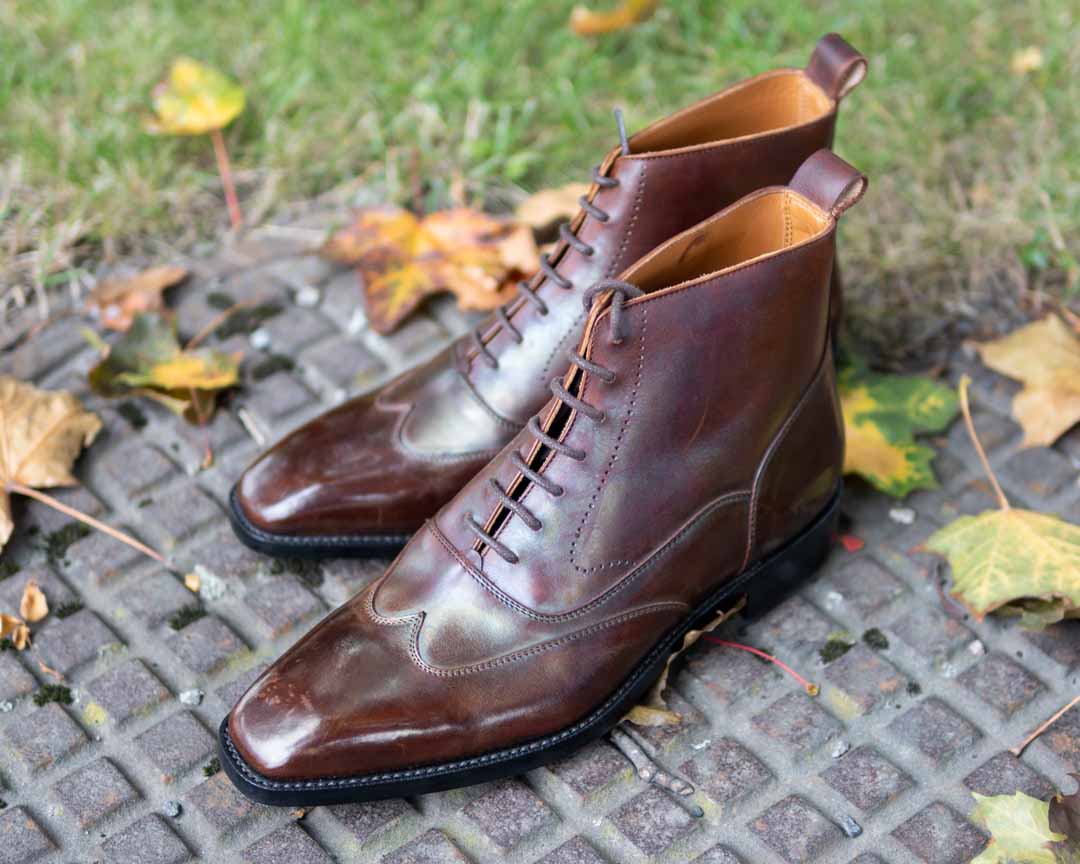
Real full-grain leather — such as the one on my Carlos Santos Handgrade or any proper dress shoe (Carmina, TLB Mallorca etc) — keeps its natural surface and grain. It breathes, lives, absorbs polish and takes a real shine. It takes on character. After a year of wear, a good leather shoe looks better than the day you bought it. After a year of wear, a corrected-grain shoe looks like it survived a crime scene. Or in typical Kostas writing, it is rubbish.
The best leathers — French calf from Annonay, Italian box calf, Horween shell cordovan — are noticeably different even to a beginner. They have depth. The light moves on them differently. It’s supple to the touch, you can see your beautiful mug on the toe cap after shining.
However, buzzwords are everywhere so I urge you to learn a bit more about leather here!
When “investment piece” actually means investment piece
The phrase “investment piece” gets thrown around so much in menswear it’s lost its meaning. Half the time it’s just a marketing line attached to whatever the brand wants to sell you this season. The same goes for the term “Handmade” or “Handcrafted”. You should not be suspicious of everything, but you should be curious enough to ask and question.
A real investment piece in shoes meets at least five criteria:
- Goodyear welted or hand-welted — so it can be resoled multiple times.
- Full-grain leather — so it ages instead of dying. In the case of my Meermin or Lethato (if you know you know) just dying.
- A timeless silhouette — No 90s square toes. No ridiculous shiny fake leathers.
- It’s not a famous designer shoe (no really, they are rubbish).
- It’s made by a heritage shoemaker with real history and experience.
If a shoe meets all five, it’s likely investment piece. If it meets 2-3, it’s alright. If it meets one or none, it’s an expense pretending to be an investment. Maybe you can write it off in your tax report.
And by the way cheap shoes that quote “limited edition,” “collaboration,” “premium,” “exclusive” are just praying on your desires. A $600 sneaker collab will be in a landfill in three years. A $400 oxford from a serious maker will outlive them all.
A Quick Checklist
Here’s a quick (but not definitive) checklist:
1. The Toe Spring, Last & pattern
If it looks outdated, it probably is. If the front part of the toe springs up and curls it is a sign of a bad shoe.
2. Smell It
If it smells like chemicals, it is probably a bad sign. Especially if you just take it out of the box and it smells bad. Yeesh.
3. Look at the leather
Real leather has pores, grain, irregularities. Just like our own skin. Take a closer look and see if you can spot something like this. If it looks shiny and plasticky, it is probably low quality corrected grain.
4. Check The Description
If it was Goodyear Welted, it would be in the description since they would be proud to promote it. Why do you think they don’t? It’s probably cemented or average Blake Construction.
5. The Price
Unless you know who you are dealing with (and you are not looking at the second hand market), if it is under $200 the shoes are most likely bad. There are exceptions such as Blkbird Shoemaker, but there are very few.
How Much Should I Spend?
Not everyone has $500 to spend on a pair of shoes. While it is considered entry level, it is still a significant amount of money.
I always said that you should go for the best you can afford up to $500. After that, the details become obsolete for people that are not enthusiasts or are just starting.
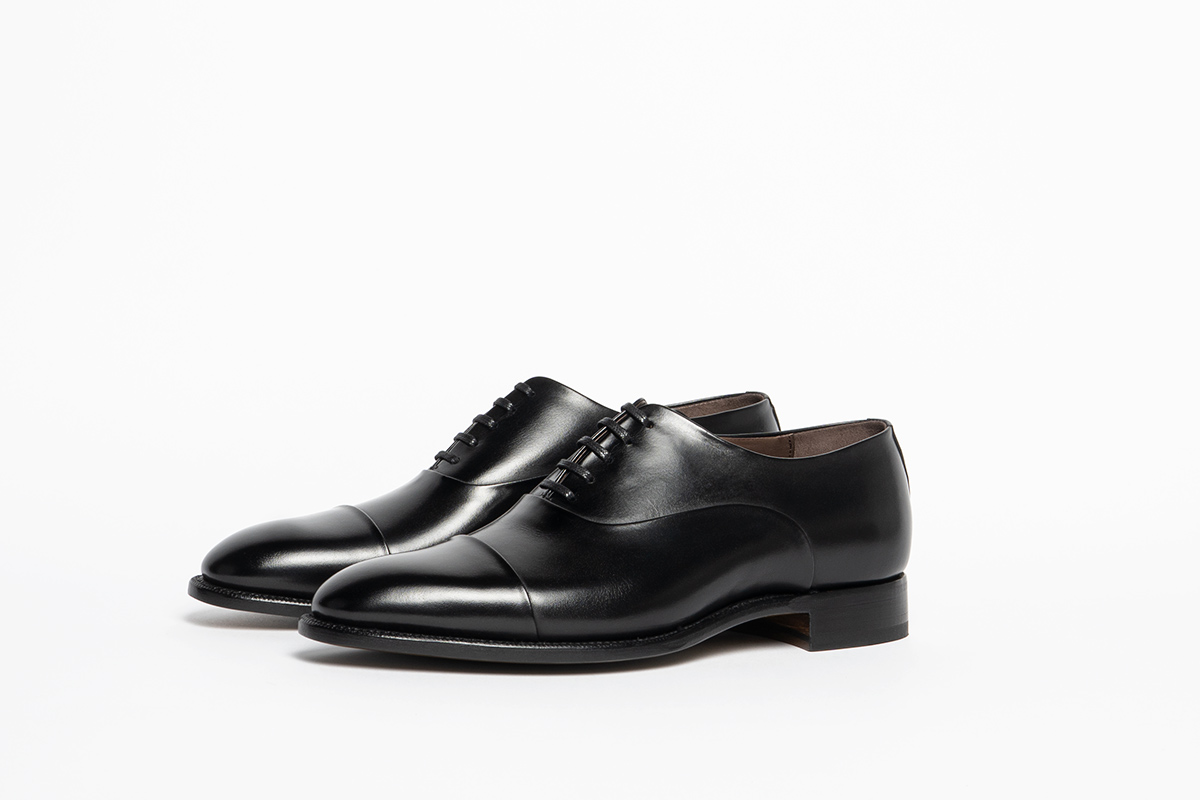
I would say $300 to $500 is the sweet spot. You get excellent leather, quality, construction and many heritage brands with real history.
If you have a lower budget, there are alternatives such as the aforementioned Indian Brands, or even Allen Edmonds in the USA during heavy sales.
Hell, there’s no reason not to consider a pre-owned, second hand loved welted shoe.
I fell in love with shoes 8 years ago and I have shoes that cost over $2000, yet I often find myself still wearing my first loves: Carlos Santos from Portugal.
I loved them so much, I quit being an Engineer to work with them. There’s plenty of other amazing brands in our space, so consider them as well. Support your local or small artisans and say no to plastic, cheap cemented shoes!
Recommendation: Carlos Santos 9899 Oxford
The verdict
Spending $400–$500 on a properly made pair of shoes is one of the cheapest things you can do for your wardrobe.
Say no to buying new shoes every year. Small constant purchases quickly add up, and all you do is encourage companies to pollute the planet and sell more garbage.
Like I said above, I’m not saying everyone needs $500 shoes. But if you are already spending $120 every year on something disposable, you’ve been effectively buying $500 shoes the whole time. You just split the bill across a decade and got nothing for it. I wonder how much money I wasted the first 29 years of my life.
Start with one good pair. Aim to have at least 3. Take care of them, polish them properly, brush them, use shoe trees. Who knows one day, you might pass them to your son. I look forward to that moment.
Thank you for reading,
Kostas Mandilaris,
Misiu Academy